
The New Asbestos Certificate in Catalonia: A Legal, Technical and Procedural Guide for the Real Estate Sector

1. The Catalan asbestos eradication law and the asbestos certificate
Law 8/2026, of 2 July, on the eradication of asbestos in Catalonia, was born with the laudable aim of establishing a legal framework that guarantees a common approach to the management and removal of this harmful material.
In short, the law seeks to mitigate the risks to health and the environment and, as the major new development for our sector, recognises the right of citizens to obtain an asbestos certificate in Catalonia, stating its presence or absence, when buying or renting a property, such as a home.
The law also deals with other fundamental issues, such as the right of asbestos victims to receive institutional support, or the obligations of the various public and private stakeholders regarding asbestos in buildings for public use. However, we will not go into them in this article, as our aim is to help real estate professionals and architects understand how to proceed in their daily work now that the law has been published.
2. Obligations of agents, property managers and related professionals
Article 12 of the law deserves careful consideration, as it focuses directly on property managers and other related professionals.
The law sets out very specific obligations for them:
- Reporting the presence of asbestos-containing materials in movable or immovable elements to the owners of the homes in the buildings they manage.
- Reporting this information to the Catalan Register of Asbestos-Containing Materials.
- Ensuring that building owners hand over a certificate of the presence or absence of asbestos to the buyer or tenant of their property.
- Assisting owners with the process of obtaining that certificate.
And it is precisely with regard to this certificate that we need to take a critical look at what its scope and content should be, who can issue it and at what point in the sale it must be handed over.
3. The scope of the certificate and the problem of legal uncertainty
For this, we must turn to Article 21 of the law. This article states that the certificate is the specific document reporting on the presence or absence of asbestos in a property at the time it is issued, and that it must be handed over whenever the property is sold or rented.
However, Article 21 simply states that the characteristics of this certificate, and who is qualified to issue it, are to be set out in implementing regulations. And, according to the first final provision of the law itself, the Government of Catalonia has one year from the approval of the law to issue those regulations.
In our view, this has not been handled correctly. Handing over a document is established as a new, immediate obligation, yet neither its content nor who may issue it has been defined.
For our part, we have no doubt that building professionals (architects, building surveyors and building engineers) have the right knowledge and experience to issue this kind of document. In fact, in Technical Building Inspections (ITE) we already routinely report asbestos-containing elements as defects of varying severity depending on their condition. But under this law, while the regulations are still missing, it seems that anyone could issue the document, undermining its validity.
4. The legislator’s technical error: “visible asbestos”
The law states that, until the regulations are approved, certificates issued in the meantime must at least state the presence or absence of “visible asbestos”.
It is striking — and in our opinion a mistake — that an asbestos eradication law should refer to “visible asbestos”. This shows a failure to appreciate that asbestos fibres are microscopic and cannot be detected by a simple visual inspection, as the Catalan legislator seems to assume.
Although experienced technicians can often tell visually whether a material is likely to contain asbestos (from its date of installation, its form or how it is laid out), absolute certainty can only be obtained through laboratory testing of a physical sample of the material.
The only valid confirmation of its presence is governed by standard UNE 171370-2, which requires laboratory analysis using Polarised Light Microscopy (PLM) or Scanning Electron Microscopy (SEM). The Catalan legislator should therefore be criticised not only for the lack of regulations, but also for the unscientific assumption that an invisible hazard can be certified visually.
5. Procedural uncertainty: when and in what form must the certificate be handed over?
Another major problem at present is procedural. The law only states that the certificate of the presence or absence of asbestos must be handed over when a property is sold or rented, but omits crucial details. It does not specify whether the document must be attached to the deed of sale, exactly how it should be handed over, or whether the buyer could waive the seller’s obligation to provide it, as happens in certain cases with the ITE.
There is therefore serious uncertainty about the procedure, the format and the order of steps.
At KAITEK ARQUITECTURA we apply real estate logic: if the presence of asbestos in a building is a defect that can reduce its value (because of the future cost of removal by specialist companies), it seems reasonable that this document should be provided before the buyer and seller negotiate the price. Just as the energy rating must be known from the moment a property is advertised for sale or rent, the asbestos status should not become a last-minute formality at the notary’s office on the day of signing.
6. Our recommendation: a comprehensive pre-purchase inspection
Our advice to anyone buying a home is always that, before signing the deposit contract, they should be fully aware of the property’s construction, planning and legal status.
To that end, it is always advisable to have a pre-purchase inspection carried out by a professional able to assess all these aspects of the building together, as the technical team at KAITEK ARQUITECTURA does.
When you commission one of our pre-purchase inspections, you not only get an assessment of the possible presence of asbestos (with recommendations for laboratory testing if necessary), but a complete picture of the building’s health: structural condition, damp, the feasibility of renovation work and regulatory compliance. We provide the technical expertise you need to negotiate the final price with confidence and avoid taking on hidden liabilities.
7. Final conclusions and a proposed certificate template
In conclusion, the law establishes a necessary framework, but it lacks regulations to standardise criteria and its technical wording is flawed when it refers to “visible asbestos”.
In this situation, we are sharing, for anyone who may find it useful, a proposed certificate template that could be used in the real estate and notarial sector until the Government of Catalonia approves the official regulations. The template is designed to protect the technician’s professional liability and to be honest about the limitations of a visual inspection.
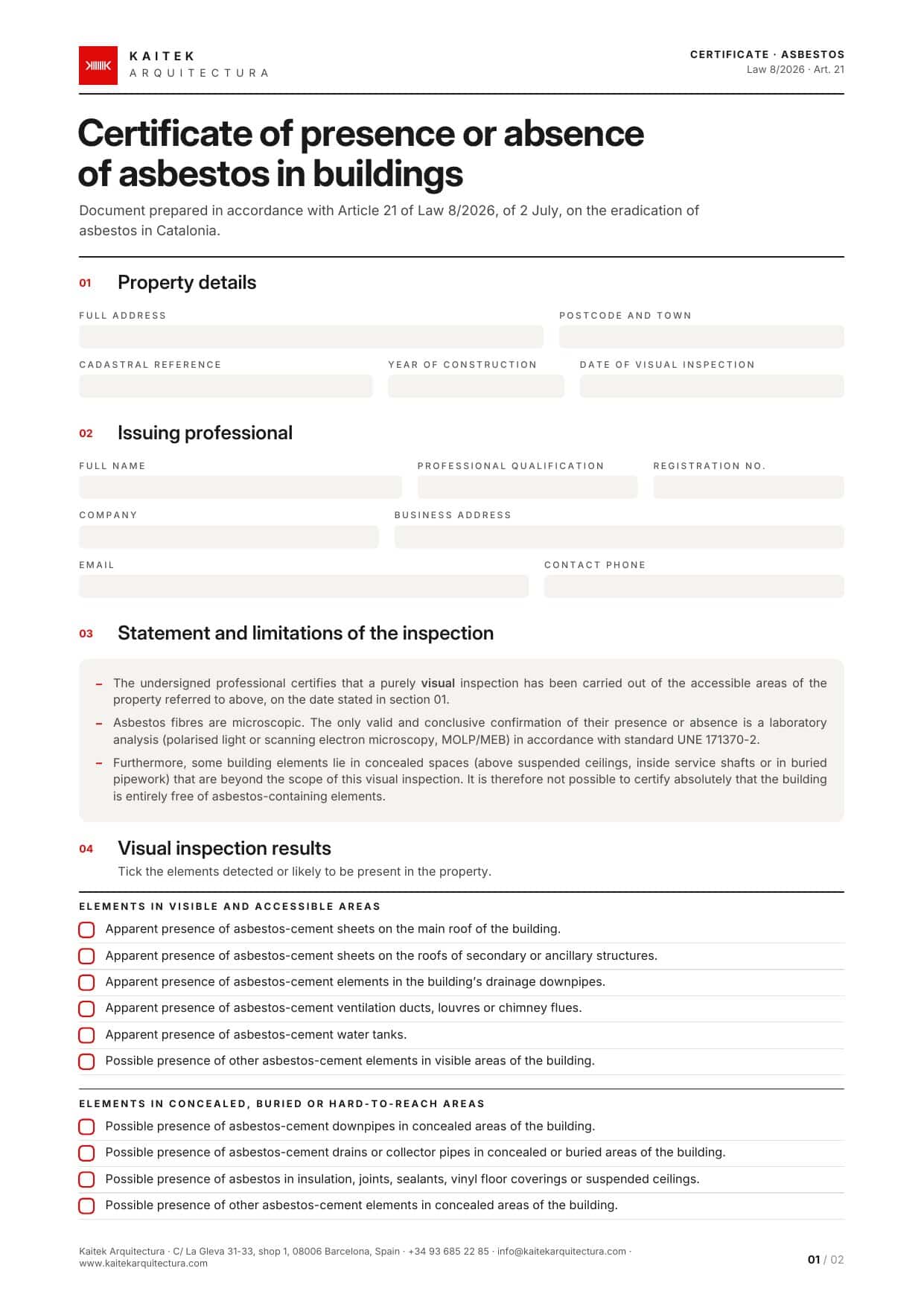
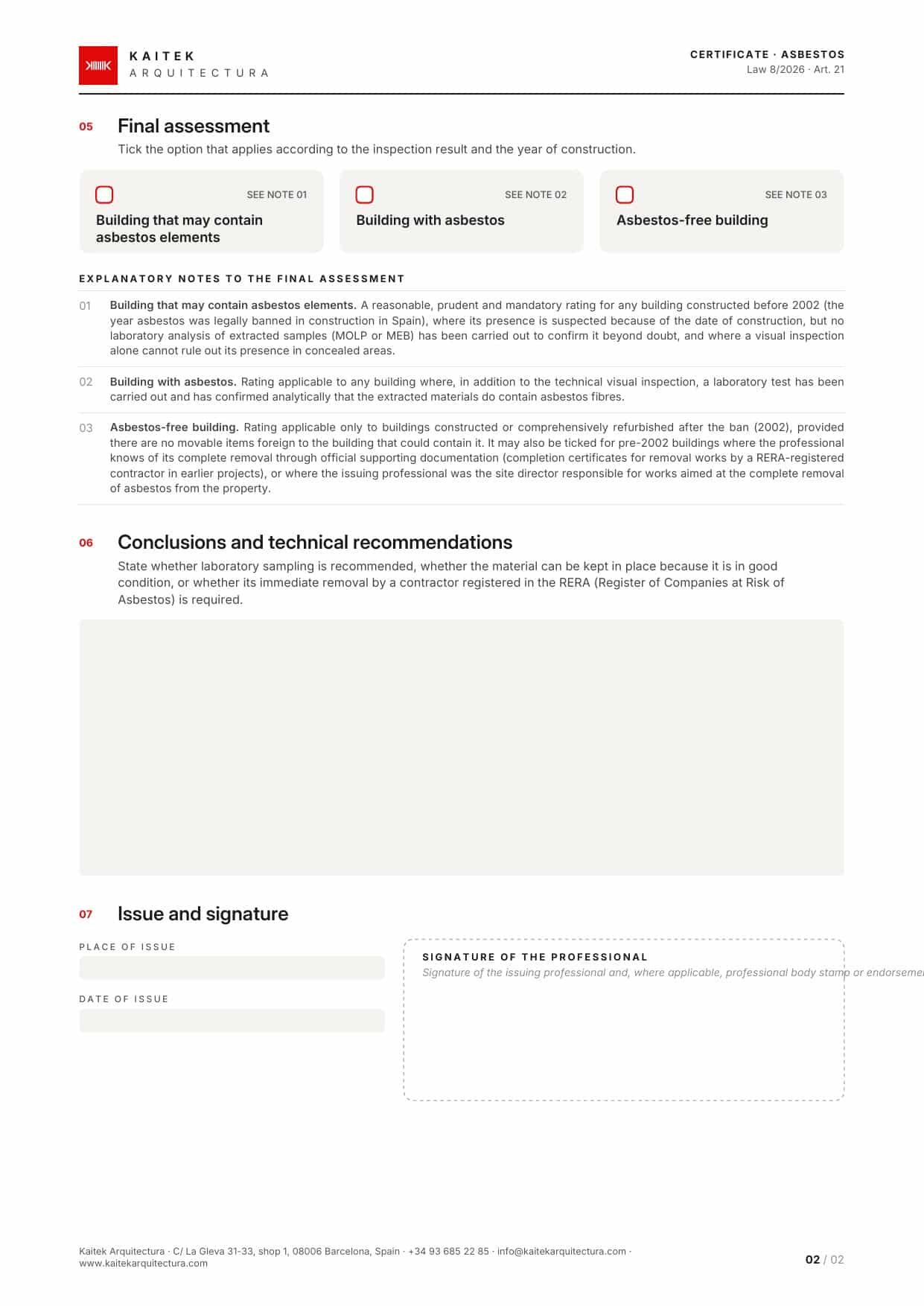
Free download: the complete template in PDF (2 A4 pages), ready to print and fill in.