
The importance of ventilation filters for health in homes

Balanced (dual-flow) ventilation is not only essential for energy efficiency; it is also very important for breathing better-quality air inside our homes: free of mould, with the right humidity, and so on.
The usual ventilation systems are indeed useful for lowering CO2 levels inside the home, as we saw in another article. However, these conventional systems cannot easily purify or filter the incoming air. For example, general ventilation, whether proper manual natural ventilation (periodically opening the windows would not help in an environment contaminated with mites or bacteria) or hybrid ventilation with a single fan in the extract circuit (which does not help in a polluted environment either).
Only a balanced (dual-flow) ventilation system centralises the supply air so that it can easily be filtered in a filter unit.
KAITEK ARQUITECTURA
As we will see below, filtration is essential because it retains pathogens, allergens and other particles that can be harmful to human health.
Types of filter
Under the ISO standard, filters are classified according to the size of the particles they can capture. Their characteristics are as follows (bear in mind that a human hair is about 70 µm thick):
- ISO Coarse filter. Captures sand, lint, seeds, fine hair, etc. Up to 100% of particles < 10 µm
- ISO ePM10 filter. Captures pollen, dust, agricultural dust, etc. Up to 90% of particles < 10 µm
- ISO ePM2.5 filter. Captures bacteria, fungi and mould spores, pollen, toner dust, etc. Up to 80% of particles < 2.5 µm
- ISO ePM1 filter. Captures viruses, bacteria, nanoparticles, soot, sea salt, oil mist, combustion fumes, etc. Up to 75% of particles < 1 µm

EPA, HEPA and ULPA filters are used in laboratories, aeronautics and other very specific, demanding applications, although they may one day start to be used for home ventilation too.
To put these filtration sizes in context with the COVID-19 virus: aerosols are micro-droplets < 5 µm and, unlike larger droplets, they can carry the virus far from its source and keep it suspended in the air for days. If the ventilation system can trap these micro-droplets, their ability to spread the virus could probably be neutralised. The CSIC study states the following (our translation):
In a place with people infected with SARS-CoV-2, they will emit droplets and aerosols containing the virus when they speak, cough, sneeze or simply breathe. Coarser particles (>5 µm) tend to settle more quickly. Finer particles remain suspended for hours or days. SARS-CoV-2 can remain active for more than three hours while part of these airborne particles (van Doremalen et al., 2020). The concentration of virus in ambient air varies with location. No specific studies for SARS-CoV-2 have been found in open environments. In enclosed environments with a high concentration of patients, the airborne concentration can be high.
A study in Japan based on contact tracing concluded that infection is 19 times more likely indoors than outdoors (Nishiura et al., 2020). In several hospitals in Wuhan, SARS-CoV-2 was detected in different spaces and particle size ranges in ambient air during the COVID-19 episode in December 2019 (Liu et al., 2020).
Airborne illnesses

Allergies
Allergies affect more than 10% of children in Catalonia. In most cases, dust mites cause the most serious illnesses or sensitivities.
Infectious diseases caused by viruses or bacteria
Bacteria and viruses from outside, and those transmitted indoors between occupants, can also cause serious illness.
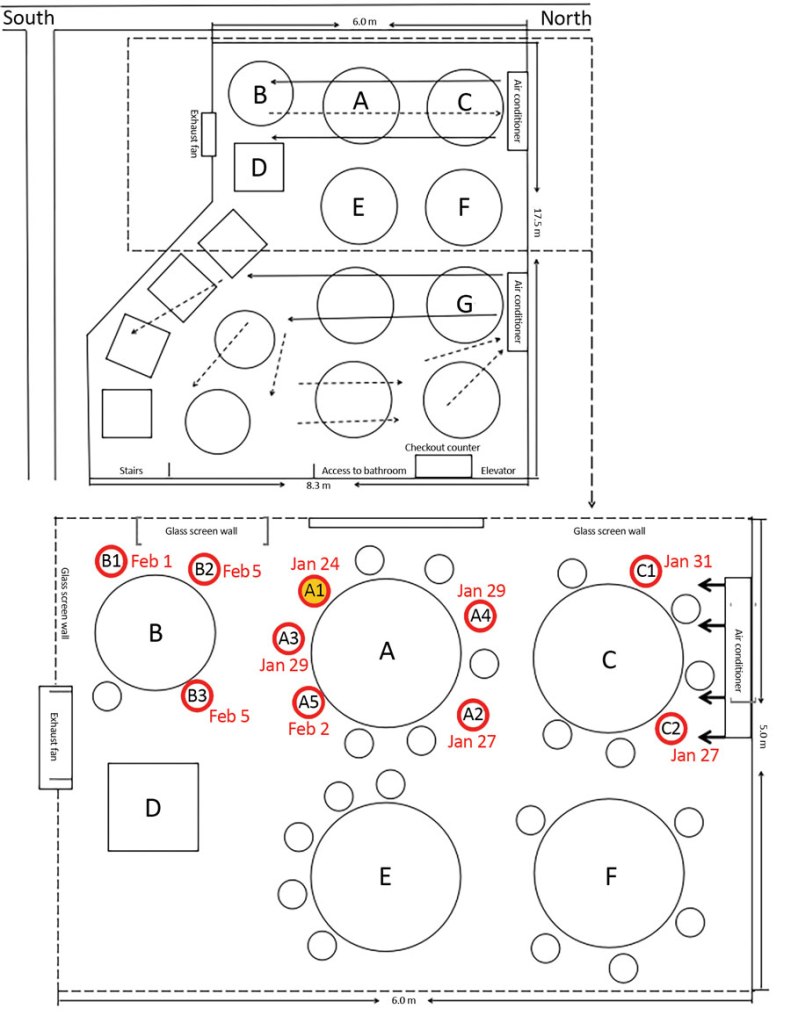
The image below comes from a scientific study published by the US Centers for Disease Control and Prevention (CDC), which concluded that a single person had infected 10 others in an enclosed space because of the air flow from the air conditioning. Indoor air flows in a home can therefore spread disease.
Lung cancer
As we saw in a previous article, high levels of radon in homes in contact with the ground have been shown to significantly increase the number of lung cancer cases.
Moreover, a close look at the statistics on the distribution of cases across Spain shows significant increases in cities. There is therefore a correlation between polluted air (NO2, CO2, etc.) in our city streets and the disease. Pollution is also linked to other types of cancer, not only lung cancer, as explained in this article. These particles are < 2.5 µm, so they would be trapped by an ISO ePM1 or ISO ePM2.5 filter.
The solution for pathogen-free air
Evidence shows that enclosed spaces, which generally have poor ventilation and filtration, are more likely to favour infection.
Many studies point in this direction. For example, according to this article in the New England Journal of Medicine, the virus can remain in the air for a long time, and this CDC article shows a high presence of the virus in rooms with patients.
In the previous example, since the virus came from inside the restaurant, the way to avoid infecting all those diners could have been a gentler, lower-volume air flow with short circuits to the filter. This could have been solved with many supply points and a high air change rate allowing frequent filtration.
If the polluted air comes from outside, the solution is much simpler (provided there is a filtration system), as the air will always have to pass through the filter, which will retain the pathogens.