
Mesh and fall arrest nets

They appear in Building Inspections, as precautionary measures, in the works in the security elements and also in many works placed intentionally, without there being a defect from which to protect ourselves.
The fall arrest nets are similar to the nets of a soccer goal and are generally composed of a fabric that is crossed to form a mesh or net. In this, the junction points between the ropes or cables are found in the crossing nodes, which can be elements such as ball joints or simply knots.
Types
Stainless steel meshes or nets are much more expensive, but their fine aesthetics mean that they can even be used to decorate spaces. Normally they have a much higher resistance than the meshes, which are usually made of polyethylene.


Utility
They can be used in the field of Health and Safety on site or to form railings or protections in buildings, for example to be used as railings. While the nets, due to their high capacity to resist loads, to avoid falls of people or material. Polyethylene meshes are used to prevent the fall of small objects, dust or detachments.
Note, in the attached photos, that the nets can replace the railings and, on the other hand, the dust-proof nets cannot (there are other elements for this purpose)
-

Stainless steel net on railing -
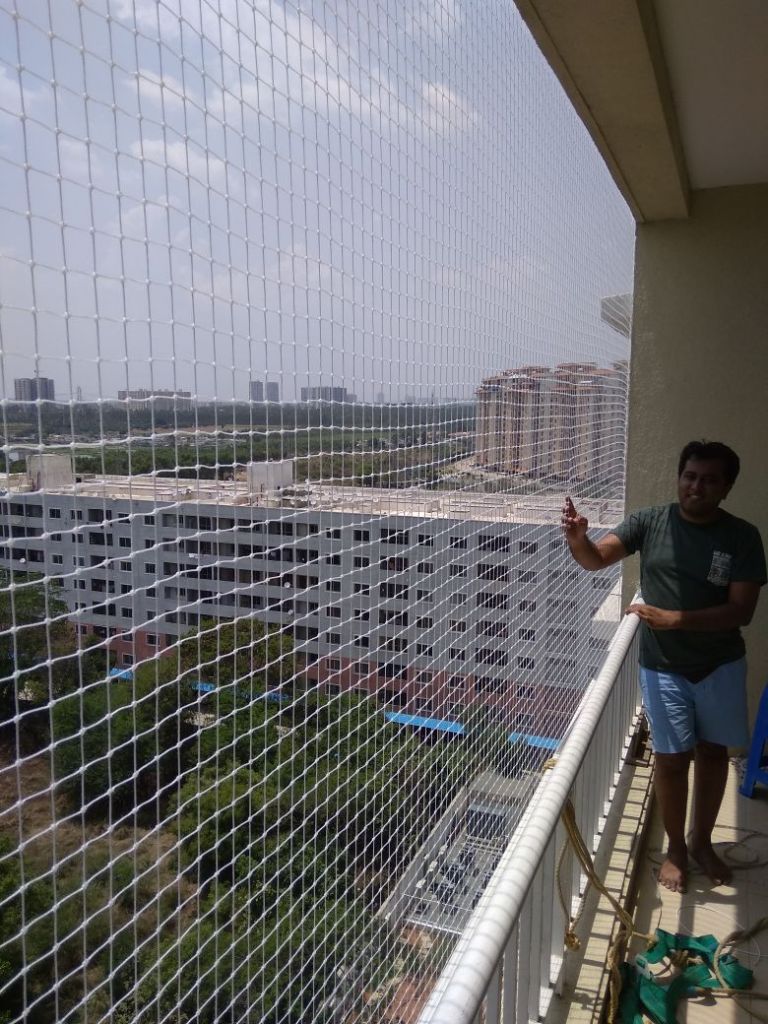
Nylon net for child safety on balcony -

Dust net on site -

Nylon fall arrest net on site -